
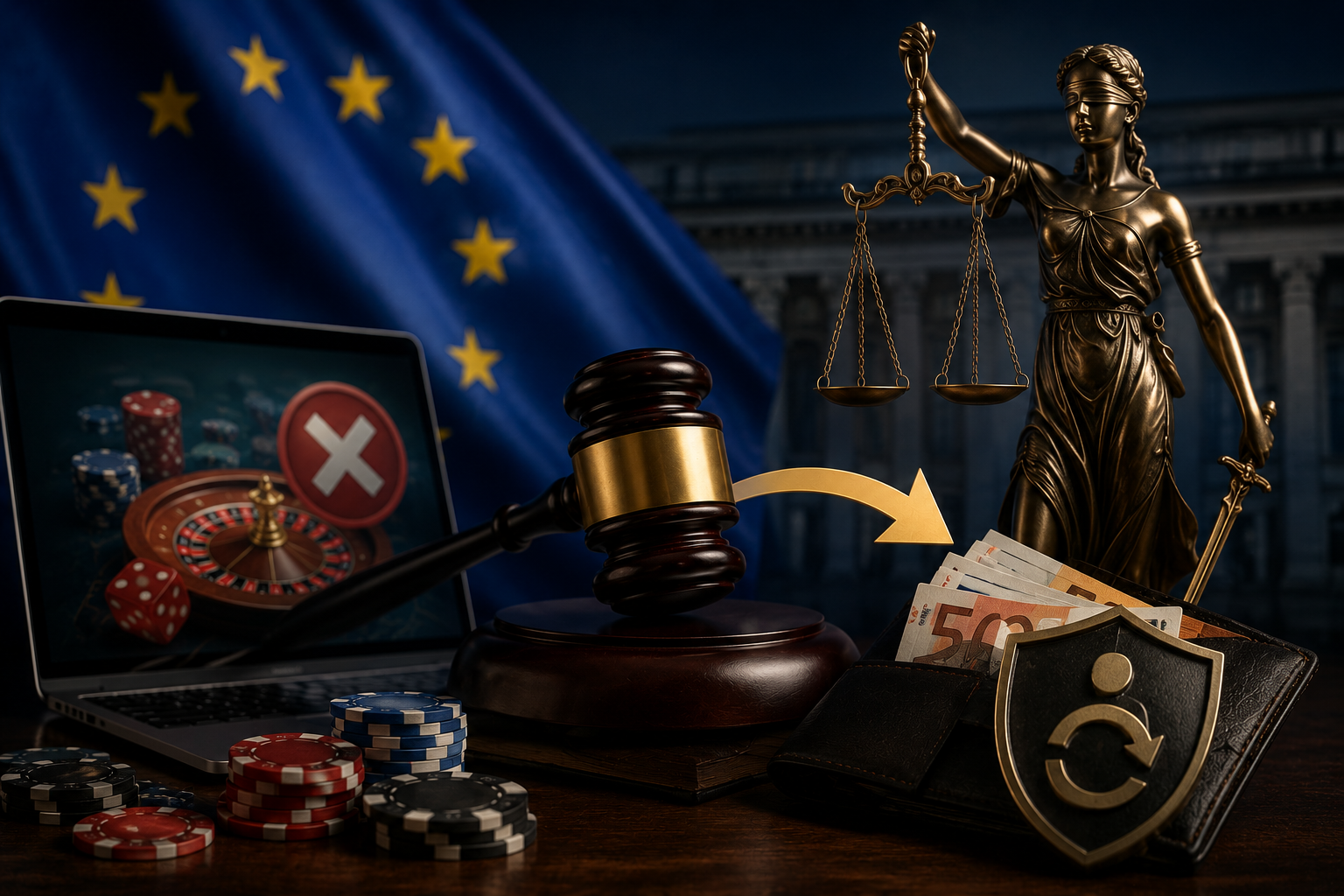

A major European court decision is sending a shockwave through Germany’s online casino landscape in 2026. The Court of Justice of the European Union has ruled in a way that strengthens the legal position of players seeking to recover gambling losses from online casino operators that offered services in Germany without the required German permission during the relevant period.
In practical terms, the ruling supports the view that Germany was allowed to restrict or prohibit certain forms of online gambling for consumer-protection reasons, even if an operator held a licence in another EU country. That matters because one of the most common defences in German reimbursement lawsuits has been the argument that a foreign EU licence should have been enough, and that Germany’s restrictions conflicted with EU rules on the freedom to provide services.
What the case was about
The underlying dispute focused on a player in Germany who used online gambling services offered by companies based in Malta. The play took place during a period before Germany’s current licensing system became effective in July 2021. After losing money, the player filed a civil claim seeking restitution on the basis that the online gambling offer was not permitted under German law at the time, meaning the contract should be treated as invalid and the losses repayable.
The key legal question was whether EU law would block that kind of claim. If Germany’s earlier prohibition were found incompatible with EU law, operators could argue that repayment claims should fail. The EU court’s ruling significantly weakens that line of defence.
Why it’s such a big deal for Germany
Germany is one of Europe’s most closely watched online gambling markets because it shifted from a largely prohibitive approach to a regulated licensing system in 2021. Before that change, many Germans played on offshore platforms that marketed themselves as “EU-licensed” even though they did not have a German authorisation for the products being offered.
Those offshore offers are also where many consumer-protection issues tend to cluster: fewer enforceable limits, weaker oversight, and no mandatory connection to German safety systems like OASIS. It’s one reason regulators view casinos without OASIS as a red-flag category in practice, because the absence of that protective layer usually signals a lack of alignment with the German framework.
As a result, German courts have been flooded with disputes over loss recovery, particularly relating to play that occurred before July 2021. The EU court’s decision is being read as a green light for national courts to treat those contracts as void under German law and to allow repayment claims to proceed, provided the specific legal requirements are met.
What the ruling changes for players and operators
This isn’t an automatic refund mechanism. Players still have to bring claims, and outcomes will depend on factors such as:
- the exact dates of play
- which gambling products were involved
- whether the operator had German permission at the time
- the evidence available from payment records and account history
- how German courts apply national rules on contract invalidity and restitution
But the ruling matters because it supports the principle that Germany can impose strict restrictions on online casino games, and that those restrictions can have real civil-law consequences. For operators, that increases legal exposure connected to the pre-2021 period and raises the likelihood of more litigation, tougher settlement negotiations, and renewed scrutiny of how offshore offers were marketed to German consumers.
The wider context in 2026
The decision lands at a time when Germany’s regulator continues to fight a parallel illegal market and when public debate remains intense about whether strict rules push players toward unlicensed platforms. Either way, the EU court’s ruling shifts the risk profile of doing business without German permission — not only from an enforcement perspective, but also from the civil-law side where financial claims can accumulate long after the gambling activity took place.
For the German market, the message is blunt: a foreign EU licence is not a universal passport, and the legal consequences of operating without German authorisation may be more expensive — and more persistent — than many companies expected.